As published in Conference and Common Room
Summer 2010
A Sky filled with stars
Bruce follows his mother’s example
Within my dining room bookshelves, nestling amongst world atlases, encyclopaedias and other such nondescript non-fiction, lie the rather florid family albums. Within these much perused volumes are snaps from the dawn of time – my parents dating, my entrance into the world as an embarrassingly fat and pink baby, my brothers following behind in similar fashion – but, in a much more neglected album, hide much more interesting pictures. It has a plainer and more modest covering than the others and, as such, is largely overlooked; its spine is simply entitled: “South Africa” and contains my mum’s photographs taken while on her gap year with Project Trust. All 145 of them. To examine its content closely was, and still is, always something of a shock: did mum really have hair as blonde as that? Why is she sitting on an ostrich?
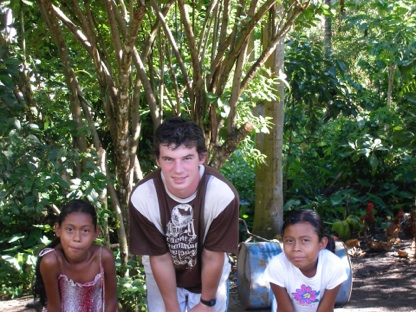
Scattered about the house are other additional subtleties of African origin: tiny clay houses which form a small village; a mask-like musical instrument; wood carvings of tribesmen; but always having had them around me when I grew up, I didn’t realise until very late that they hinted at something far from normal: I had thought nothing of them. Until I started expressing an interest in taking a gap year – and the stories came forth.
A gap year had long appealed to me. 7 years of primary education, 6 years of secondary education followed by a further 4 years of tertiary education all rolled one on top of another? Utter madness. A break was needed, if only to preserve my sanity. I got involved with Project Trust as a direct result of my mum. She was very quick to point towards the support structure which an organisation like Project Trust could provide. Inevitably, I gravitated towards Project Trust, although I did show some interest in other organisations sending teenagers abroad, but Project Trust’s record is hard to contend with: 40 years of operation is quite simply staggering. Also, the places that Project Trust could offer to send me were innumerable and fascinating: almost every single country was far-flung; none were the surf-swim-snorkel-build-something-afterwards-then-go-home-after-three-weeks type of experience which sadly typifies Gap years at the moment.
The wildness and remoteness of some of the countries was a real attraction for me – Guyana, the country I would go to and eventually fall in love with, I had never heard of before. Further investigation revealed nothing: Guyana, once a proud colony of the British Empire, has been largely abandoned and forgotten. Next to no useful information could be gathered on it – until, miracle of miracles, a BBC documentary was released 3 weeks before I departed, documenting the abundant wildlife of Guyana. What followed was an eye-opening 3 hours of television education – I had never seen video or pictures of Guyana and the series was just what I needed to get me really interested in the country, wildlife and people of Guyana. I think it also terrified my mum to her wits ends when she saw just how remote a place I was nonchalantly departing to.
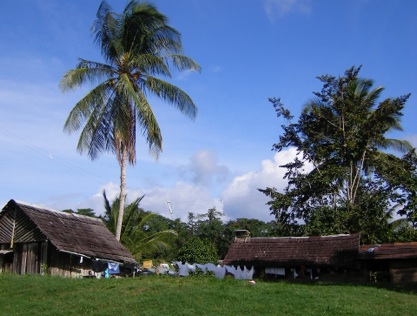
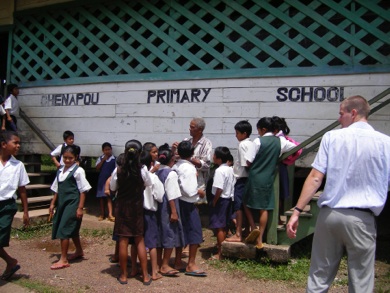
Ironically enough, I spent my break from the education system…in the education system. I was employed by the Ministry of Education in Guyana as a volunteer teacher to teach in a remote rainforest village’s local primary/low-secondary school. When one talks of being pushed in at the deep end, I can think of no better embodiment of the phrase than the situation my partner Matt and I found ourselves in: we were the first volunteers from Project Trust to be sent to this village (Chenapou), we were the first white people to be spending more than 6 months in the village, we had been given rudimentary teacher training by Project Trust, we had no means of communication with the outside world apart from a very haphazard mailing system, we arrived in our accommodation to find literally nothing inside it – we had to ask around the village for a spoon and cup each, we arrived in our village on Sunday afternoon and we taught our first lesson on Monday morning. And yet, because we had been to secondary school, we were automatically more qualified academically than all but the Headmistress, and as such got almost twice the wage of the other unqualified teachers; Matt and I worked out that we were paid about £1.50 per hour.
There were, as to be expected, things to get used to: in terms of work, the teacher status took a while to get to grips with; the children took a long time struggling to understand our strange accents when we talked and, just the same, us with them; although the syllabus was basically the same standard as GCSE or Standard Grade, it certainly didn’t mean that we knew it all – there were several occasions where I had to teach myself some obscure (and, more often than not, obsolete) item hidden in the syllabus before I taught it in school the next morning.
Outside of work there were far, far more things to get used to: from the sudden absence of running water, electricity and sanitary facilities in our house (and much of the village for that matter) to the intense humidity and heat throughout the day; from the shrieking of insects and the occasional bat, which felt the need to fly into our house, and then into all our walls, at night, to the omnipresent cockroaches which quite literally got everywhere. It was definitely a step outside of my comfort zone and at times things were a struggle, but at the end of the day, that is what I wanted my gap year to be: something out of the ordinary, something challenging, something rewarding and something that I would ultimately be proud to say I did. It certainly turned out to be all of them.
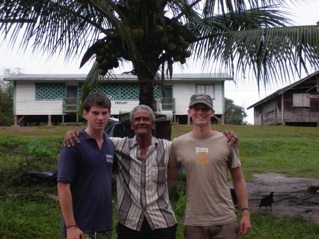
During my year I saw some amazing places: the rainforest, Machu Picchu, the utter blackness of night and a sky filled with stars; met awe inspiring people: Dru, school Headmistress, Uncle Mac, village elder; and did some truly unbelievable things: gold mining, eating “bush meats” freshly caught in the rainforest, and helped all the unqualified teachers pass their English exam.
Now at university, when asked what I did last year and I reply: “Gap year”, I can see the eyes glaze over in front of me. I can tell what they think: huh, run-of-the-mill. I wonder if he went skiing or backpacking in Australia… I enjoy seeing them scrabble around the floor for their jaws when I reveal the details.
I would have had it no other way.
I owe much to many people who made my Gap year in Guyana so enjoyable and rewarding. I think the things that I saw and encountered whilst over there have changed the way that I see the world indefinitely. I feel unique and enlightened, even amongst the vast majority of people who opt to take a Gap year, just for doing something so different and beneficial with my time last year. I know that I shall never regret doing it.
Bruce Torrance