Dear Mr Mason,
I have completed my gap year project and arrived back in the UK this week so am delightedto be able to write my report for you and the Trustees of the Bulkeley-Evans Scholarship
Fund. My biggest thanks to all of you for choosing to support me throughout my time in Georgia.
In my application I set out my main objective as working closely with an arts collective which is part of the Caucasus Culture Exchange (https://www.caucasuscultureexchange.org), with the aim of serving the culture and arts of minority ethnic groups in the Caucasus region. I am delighted to say that I feel I have met this goal, and then some. For the first four months of my year, my main role was looking after and helping homeschool the kids of the family which founded and directs the Caucasus Culture Exchange (CCE), and by supporting them daily through childcare I was able to support the projects being pursued by the CCE. The family has five children with ages ranging from 3 to 13 with another one on the way, all of whom I absolutely love. I helped with all the sides of homeschool, from maths to grammar to ancient history and greek mythology. I really found a passion for spending time with kids and watching them and helping them learn and discover new things about the world. Several times I stayed with the kids for longer extended periods of time so that the parents were able to travel to pursue the projects they have going on at the CCE. I am a firm believer in supporting people who already have the skills, which I do not have, to do something and learning from them through observation.
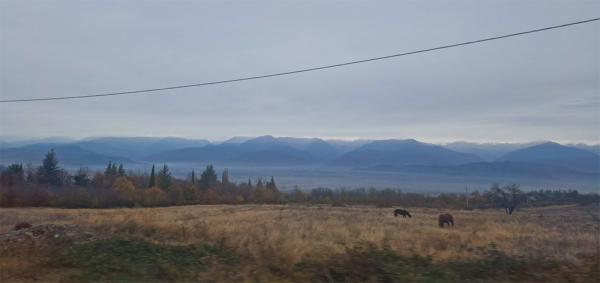
One of the projects I have supported through childcare is an ongoing recording project with a small ethnic people group up in the mountains of Georgia. The people group only has 3 villages in Georgia with another slightly larger population living over the border to the North in Russia, with a total population globally of just under 3,000 people. As I discussed in my application letter, many of the people groups in the Caucasus Mountains are losing much of their cultural heritage, including their arts and identity. As such one of the most exciting projects carried out by the CCE over the last year has been building relationship with the only poet who writes in the language and cultural style unique to this people group and helping him record them, write them down, publish them and share them with his wider community, thus supporting the arts of this tiny nationality in the remote mountains of Georgia.
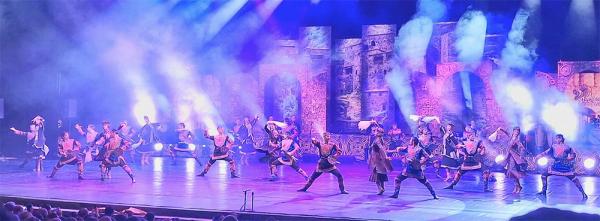
There have also been several trips to Azerbaijan to another ethnic minority people group, native to the mountains there and to the North in Russia. This people group is a little larger with a population across both countries at around 55,000. What has come out of this project in Azerbaijan is a series of mini-documentaries, each one focusing on a specific local art form, many of which are unique to these mountains. The project is currently in post-production and I am very excited to see the final results once they are released. Many of the art forms are ones that I grew up seeing and hearing about where I grew up in the Caucasus Mountains just North of the Russian border so I am doubly excited and privileged to have been able to serve and support this project.
Another project that I heavily supported through childcare is the establishment of a mums and babies group at the CCE. It is run by the mum of the kids I was working with, who is a certified professional midwife and whose passion is serving women in homebirth, birth education and maternal health. She believes in supporting mothers and families in order to help cultures thrive. I feel incredibly honoured to have been able to work closely alongside her for the four months I was with her kids every day. She is an incredible, gentle but passionate woman, who has taught me so much wisdom about the world and the humble ways in which we can serve other people on a daily basis. It was a privilege to work with her. The mums group has been meeting every ten days since it started in around October and is now a thriving community of women, both local and expats, who bond over the highs and lows of early motherhood, an experience shared, I imagine, across all cultures. The sharing of culture, passions and life that happens at the mums group is completely in line with the values and goals of the CCE and it was so much fun for me to be able to look after the kids while it was going on whilst also learning so much from the women themselves.
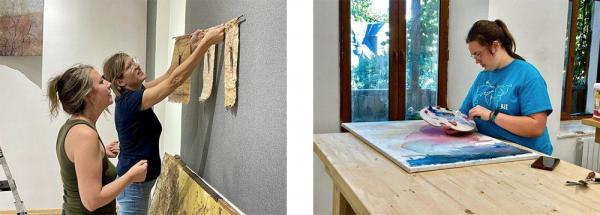
The CCE is also home to a gallery and coffee shop both of which exist with the goal of supporting and giving local artists a space to shine and feel at home in. I have worked in the coffee shop as a stand in barista throughout the year as well as having one shift a week while I was working with the kids in the autumn and winter. This was a really great experience for me as it taught me a lot about hospitality and gave me the opportunity to learn new skills. It was also really fun to be able to help and serve at the CCE in more ways. Part of that role was hosting the front of the gallery.
The gallery is a space which very purposefully and intentionally exists to serve and host local artists. We had several exhibitions over my time in Georgia and hosted around 6 or 7 artists local to the countries of the Caucasus. One exhibition was particularly interesting. The artist was from a minority people group in Dagestan which is in the Russian part of the Caucasus and her exhibition was part of a NGO she manages which helps women experiencing domestic violence and abuse. The exhibition was poignant and challenging and it was amazing to be part of the team hosting it.
A project during February which was very different to all the others but which I enjoyed immensely was the building of a professional recording and editing studio in the CCE building. It was built so that the artist that the CCE is engaging with can have a space to record in and equip them to produce and share the art that they make with their wider community.
One of the problems faced by artists from the minority people group in the mountains is that there are not many of them and often their villages are very remote making it difficult to get their art out there. This is one of the factors that contributes to a lot of the minority community arts dying in a rapidly digitalising world. The studio will help artists, primarily musicians, but others as well, to be able to continue sharing their art.
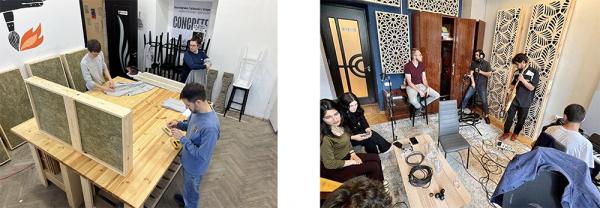
For the second half of my time in Georgia I was one of the artists in residence at the CCE as part of a cross cultural arts training program. The program focuses on equipping those participating in ways to serve, support and nurture a community and their arts. We had class twice a week on how cultures interact with art as well as how we can helpfully engage with them. Alongside the theoretical training we also had practical chances to learn through actually serving the artists in the communities around us. The CCE building is often a place where artists gather to share ideas and work on projects together. As part of that environment and as one of the artists in residence I was able to engage with many of the people who came through, hearing about their projects and being part of the busy artistic environment that nurtures such a wide range of artists, including myself.
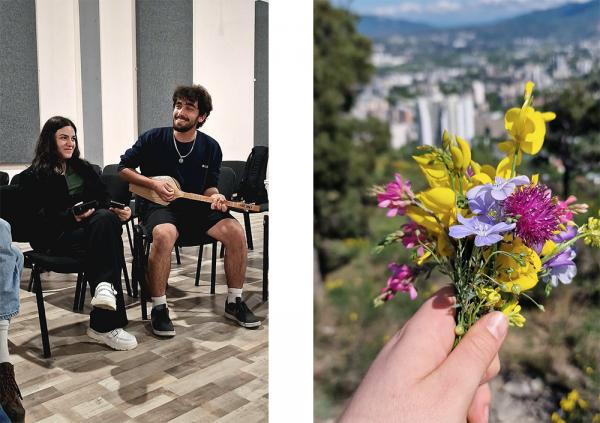
By far the most exciting project that I was personally involved in was a series of songwriting workshops to help young Georgian musicians write in their own traditional styles. This was such a fascinating experience for me as I am neither from a musical background nor Georgian so much of the training I had been receiving had to come in very strongly. The theoretical knowledge we had discussed extensively in class in short boils down to learning to observe a community’s arts, respect it, engage with it and ask them the right questions which help them to think about their own arts. We were never the ones teaching about the local music style. This is important because I believe that only people from within a particular culture or people who have spent enough time in one can make art, in this case music, that truly comes from the heart of the community. We were not part of Georgian culture so what we were doing was more like facilitating their art, helping them think about their own music. In short we were teaching them to teach themselves: to become aware of a cultural knowledge that they already have from a lifelong exposure to it, and to create from that deep, personal and often unconscious knowledge to make the music that they wanted to be making and which truly reflected their culture. It was an honour to be part of this project and to observe the joy that writing songs and making music in their heart culture brings to people.
A few unexpected projects also popped up as the year went on. As I worked with the kids in the autumn, I became aware of how isolated many kids of expats end up when living abroad. These kids often get called Third Culture Kids or TCKs for short. They are kids whose parents are from one culture but they grow up in another culture, thus often not feeling like they fit into either one and creating their own ‘third culture’. They often end up feeling underrepresented and unseen by much of the world around them. As someone who grew up outside of my parents’ culture I am a TCK. There are quite a few expats in Georgia who are there to help and support the people of the Caucasus and who often cross paths with the CCE and as such I came across a lot of TCKs too.
As I worked with the kids in the autumn I realised how little opportunity many TCKs have to be involved in the more collaborative artforms, ones that need other people in order to work, such as making music as a group or acting. Because of this, and because as a TCK I wanted to be able to help my own global community I carried out a few projects in my own time outside of the time I was working with the CCE. I started a small acting club for any TCKs in Tbilisi that I knew (by the end of the year I knew quite a lot) and we performed a short skit, that a friend and I wrote, at a church talent show. Whilst the scale of this project was very small it gave the kids and teens who came a chance to collaborate and create with other people.
Most of them had never had the chance to act before and I believe that those that came really enjoyed it and really appreciated the opportunity to give it a go. Another project I carried out with the TCKs who I knew in town was a short film project. I wrote a script based on my experience as a TCK and found a cast and crew to shoot it. It was very important to me that the whole cast and crew were TCKs as I wanted to make a piece of art that represented us as a community well and which gave those involved a go at making such a collaborative piece of art. I am immensely proud of the final result and of all the TCKs involved in making it, it is probably the piece I am most proud of out of everything I have made as an artist.
One of the CCE’s core beliefs is that in order to serve artists we must be thriving artists ourselves. As a result, whilst receiving training in how to serve and support artists, particularly ones from underrepresented communities, I was also able to carry out art projects of my own, one of which was the film project mentioned above. These did not directly tie into serving the people groups of the Caucasus mountains but I have felt myself grow and flourish as an artist as I never have before this year. I feel like I have truly got to know myself as a creative and uncovered things I did not know about myself.
Through working with all the artists around me, in projects at the CCE and by embracing the creativity within me in my own time I have discovered a real sense of calling in my life and a strong passion to be an advocate for the arts, particularly the arts of underrepresented communities, and have found the arts to be far more important than I ever imagined. They give a community a sense of identity, a shared story and mutual understanding in a way nothing else does. This year has taught me so much and has given a sense of direction and drive as I step into what is next. Thank you so much for your support this year, it has helped make this year possible and I am incredibly grateful,
Blessings,
Elizabeth Stunt