I consider it a shame that I had to leave Morocco, even after such a long time spent out there. For three months, from late September to early December, I had the privilege of working out in the country as an English teacher at different yet equally rewarding schools and establishments.
Having just finished my A Levels at sixth form and only reached the age of eighteen not two months before I left, it seemed at first quite a frightening prospect to leave my family and friends for the months leading up to Christmas and depart for a volunteer project on my own. More so was the knowledge that I’d have to find enough money to fund this adventure abroad, and therefore special thanks goes to the Bulkeley Evans Fund for their generosity before I departed.
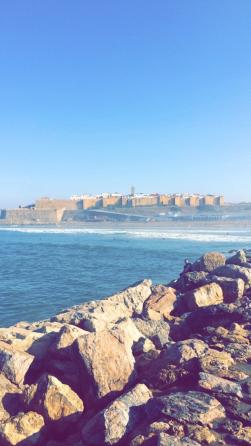
Walking through the airport terminal in Casablanca was a daunting task at first; completely alone in a foreign country with naught else but my suitcase, backpack, and a good level of French to help me get by; however, it was not a difficult challenge to become acquainted with the Moroccan culture and find it easier day-by-day to make my way around. Many complain, fear, or warn of the horrifying “Culture Shock” which countless travellers and tourists tend to experience when venturing into foreign lands – Culture Shock? Struggling to get accustomed to the way of life out there in Morocco where money, language, food, behaviour, and society were all different? Well, I count myself fortunate to have been subject to the entire opposite of such a dreaded thing. I practically threw the idea of ‘Culture Shock’ out of my window – one which boasted a splendid view onto the Place El Joulane where one can find the largest church in Morocco – and embraced the culture wholeheartedly.
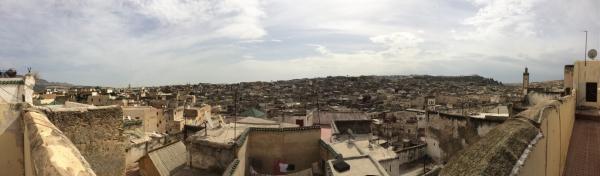
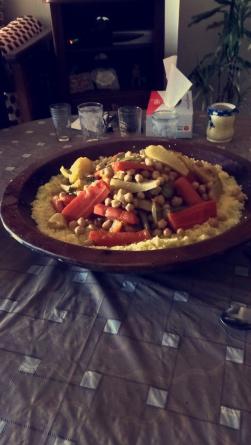
I found that Moroccans are naturally hospitable in their social nature, for many a time was I invited to a friend or students’ house on a Friday for couscous, or to come drink tea for the afternoon, or, on one rare occasion, to meet a certain friend’s elderly grandparents in the medina who had never met somebody of Caucasian origins. Luckily for them, I fulfilled their grandparents’ goal within a few weeks of arriving in the country. Morocco quickly grew to become something of a home to me where everybody, whether it be the local shopkeeper or people on the street, acted in a welcoming and friendly manner. The host family I stayed with acted akin to my own parents, despite being considerably older and with much different lifestyles.
The family were Muslim, and while being an atheist myself, there was no bridge between us. Habib (the host dad) and I shared lengthy conversations about philosophy and the differences in religion, points about our own cultures, and general discussions of things we liked and entertainment – which, I must say, was undoubtedly helpful for my French as he didn’t speak a word of English, and I was pushed to test my own ability in challenging vocabulary which I’d rarely used beforehand. The mother, Nezha, was endearing and caring, and acted as if I were her own son (her actual one being away in Poland to study) by treating me to delightful homecooked dinners and visits to the local café and gardens. Even now I see them as something of a ‘second family’ and hope that I may get the chance to stay with them once more, if only for a week, to spend time with them and have a good catch-up.
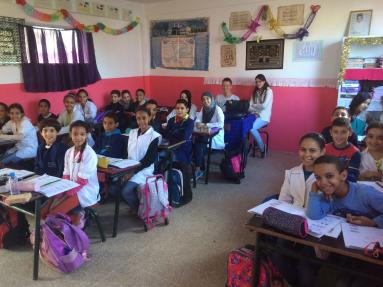
My project in the heart of Morocco was as equally rewarding for my social habits as it was for language. I was positioned in the city of Salé, across the Bou Regreg river from Rabat, where I worked in separate places: At one point as a teaching assistant for men and women in a small, local culinary school, and the majority of my time in a fantastic institute for primary and secondary school children. In summary of the culinary school, I can say with confidence that my grasp over French grammar and fluency improved tenfold while I communicated with people from a wide range of backgrounds (Berbers, Spaniards, a handful of immigrants from the Ivory Coast). It was quite an easy beginning to my project, but attendance was sadly low and so I chose to start at another school where I’d have more time to do my work.
In truth, I found that during all of my teaching project the Egyptian Insitute in Koas, Salé was my most favourite place to visit. The school was far different from any of the dusty and litter-strewn education centres I’d witnessed in some towns and cities across Morocco, instead taking on a much more modern education system with well-trained teachers, an abundance of resources, and books aplenty for the children to work with. Not to mention, the school held a vibrant and lively atmosphere with the young students rushing about to play beneath the trees in the yard, and most, if not all of the kids possessing a true excitement about learning and working in their subjects. I sat in on classes with the older range of the primary school (ages eight through to ten) and the first year of the secondary school, providing the students with access to a natural English speaker.
I am glad and extremely happy that I chose to visit Morocco for this sort of project in knowing that I truly helped people learn English as I could see the results of my work first-hand. Despite the fact most of the children already spoke either a small amount of the language, or had a fairly good level of English for their age, I felt that I managed to give them the chance to practice and perform with somebody who wouldn’t stick to the simple stuff. Yes, I admit that I did cover introductions, colours, and all sorts of vocab more times than I can count, yet I was there for the children to talk to about matters and subjects which mattered to them. I will thus not tell you how many times I discussed the success of different football teams in the World Cup or how much I enjoyed watching Shrek the first time, mainly because I feel like I really have had enough of it over twelve weeks of chatting ‘footie’ and ‘favourite films’.
Putting the actual work I did for my project aside, I feel that living in Morocco was a real life experience that will stick with me for many years to come. The food was absolutely heavenly and I simply could not get enough of all the various tagine dishes, partly because they were so different and delicious, and partly because I eventually grew a bit fed up of gorging myself on couscous dishes every week. Not only that, but I could go out and travel the country, and it was an amazing opportunity I will surely not forget – I saw the mist-clouded mountains of Akchour and Chefchaouen, the bustling medinas and markets of Fes, rode horses into the forests at Ifran to see the wild monkeys amongst the trees… and yet I still didn’t see enough. Morocco’s countryside is so varying and different wherever you go that three months was simply not enough to see everything while coping with my work schedule.
I would not give up the experience for the world, as it has helped me gain more confidence, maturity, language skills, and independence. Thank you to all who helped make my project possible, and I aspire to visit Morocco again to continue where I left off: whether it be volunteering once more, hitchhiking about the countryside, trekking on a camel in the Sahara, or even doing something as simple as playing a game of pool with the friends I made out there.